Jackson Elite Roofing provides roof leak repair in Jackson, NJ, serving surrounding cities including Vista Center, Cedar Glen West, Leisure Knoll, Leisure Village West and Plumsted. After more than 20 years of chasing leaks through attics and across roofs, the one rule we hold to is simple: we find where the water actually gets in before we price anything.
That means every leak call includes the attic as well as the roof. Water can travel along a rafter or the underside of the sheathing for several feet before it drops onto a ceiling, so a stain in the hallway can start at a vent pipe over the bathroom or a flashing joint at the chimney.
Once we have found the entry point, we fix that point properly and tell you whether the rest of the roof is sound. A leak is rarely a reason to replace a roof, and we will not use one as an excuse to sell you a new roof you do not need.
How We Trace a Roof Leak
Starting With the Stain and the Weather
The first clues are where the stain is, how big it is and when it appears. A leak that shows up in every rain is different from one that appears only in wind from the east, and both are different from one that only drips during a thaw.
We ask about timing and look at the stain from below, then use that to decide which parts of the roof above are most likely. That narrows the search before we climb a ladder.
Following the Water in the Attic
In the attic we look for darkened or soft sheathing, wet insulation, water trails on the rafters and rusty nail tips, then follow them uphill toward the source. A flashlight often shows a pinpoint of daylight or a damp ring around a penetration.
This is the step many roofers skip, and it is why leaks get repaired twice. Patching the shingles directly above a stain does nothing if the water is coming in six feet higher at a cracked pipe boot.
Confirming the Source on the Roof
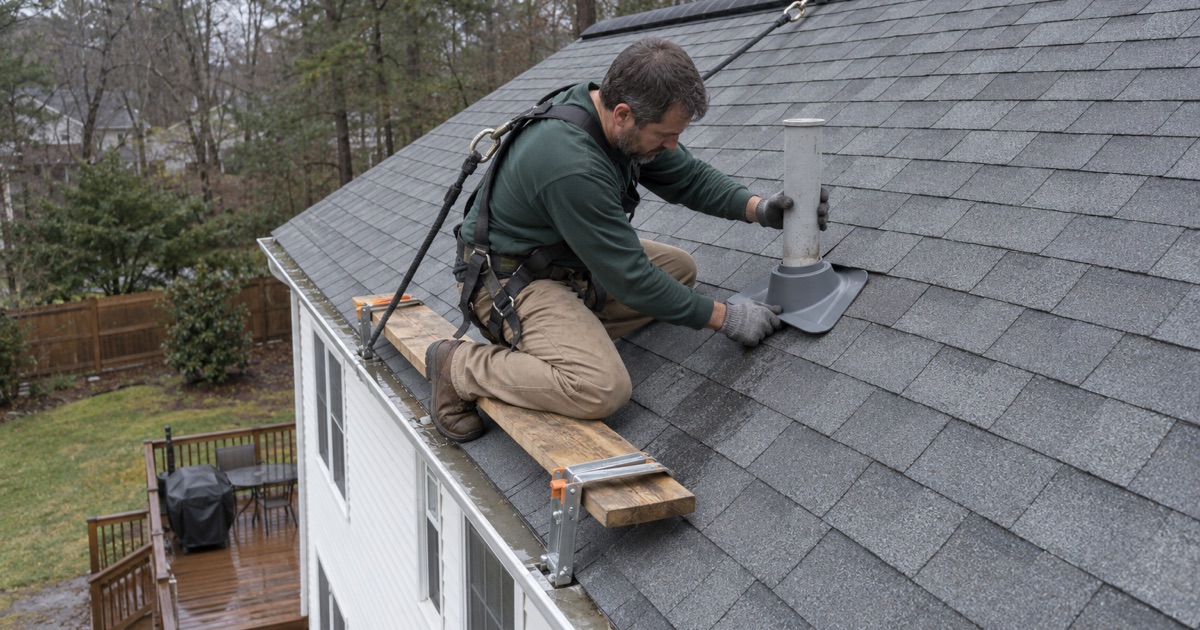
On the roof we check what the attic pointed to: the boot, the flashing joint, the valley, the shingle course or the skylight curb. We photograph the failed part close up, so you can see what went wrong and why the repair is needed.
When the cause is still unclear, we can test a suspected area with a controlled water run while someone watches from the attic. It takes longer, but it is far cheaper than guessing.
Where Roof Leaks Usually Start
Plumbing Vents and Pipe Boots
The rubber collar around a vent pipe cracks and shrinks with sun exposure, often years before the shingles around it are worn. Water then runs down the outside of the pipe into the attic, often staining a bathroom ceiling or a wall near the pipe chase.
We replace failed collars with new rubber pipe boots or lead flashing boots worked under the course above. A dab of caulk around a cracked boot buys a few months at best.
Chimneys and Sidewalls
Chimneys leak through worn counter flashing, cracked mortar joints, a damaged crown or a missing cricket on the high side, where water pools against the brick. Sidewalls leak where step flashing was reused, nailed through or never installed, and where a kick-out flashing is missing at the bottom of the wall.
We rebuild flashing at these joints with new metal and, behind wider chimneys, add a cricket to divert water around the stack. If the masonry itself is the problem, we tell you and explain the chimney repair separately.
Valleys, Skylights and Dormers
Valleys carry water from two slopes at once and fill with pine needles that hold moisture in the channel. Skylights leak at the curb flashing, at the glass seal or from condensation that looks like a leak, and dormers leak where their small roofs meet the main slope.
We clean and reline worn valleys, reflash skylights with the correct kit and rebuild dormer flashing. When a skylight’s seal has failed, we tell you whether resealing is worth it or the unit should be replaced.
Gutters, Drip Edge and Ice Dams
Some leaks are not on the roof at all but at its lower edge. A gutter hung too high or packed with needles backs water up under the first course of shingles, and a missing drip edge lets runoff wick onto the fascia and into the wall.
In winter, warm air leaking into the attic melts snow that refreezes at the cold eave and backs up under the shingles. We repair the damage, install ice and water barrier where the roof is opened and point out the insulation and venting changes that stop the dam from forming again.
When the Leak Is an Emergency
Emergency Tarping
When a branch, a gust or a failed section has opened the roof in the middle of a storm, the first job is keeping more water out of the house. We secure a tarp over the damaged area with battens rather than loose weights that slide off in the next gust.
The permanent repair follows once the roof is dry and safe to work on. We photograph the damage before and after tarping, so the record is complete for any claim you make.
Storm Leaks and Insurance
Jackson has large pine and oak stands, and storms such as the two EF-2 tornadoes of April 1, 2023 show how quickly a limb can turn into a hole in the roof. Leaks from that kind of sudden damage are generally what homeowners insurance is meant for.
We photograph and write up storm damage for your own claim and can meet the adjuster on site when you ask. Negotiating the claim on your behalf is a licensed public adjuster’s role in New Jersey, so we leave that part to you.
Protecting the Inside of the House
While you wait, catch the water, move belongings and photograph the stain and any damage. A bulging ceiling can be drained into a bucket through a small hole at its lowest point, which often saves the drywall.
After the roof is fixed, we check whether insulation in the leak area is soaked and should be replaced. Wet insulation loses its value and can keep a ceiling damp for weeks.
Repair or Replace After a Leak
When a Single Repair Is Enough
If the leak traces to one failed point and the rest of the roof is sound, a repair is the right answer, even on a roof that is twenty years old. We quote that repair on its own, without bundling it into a bigger sale.
When Leaks Mean the Roof Is Finished
When several areas are leaking, the shingles are curling or bald across whole slopes and repairs keep failing next to the last patch, the roof itself has reached the end. We show you what we saw and give you a straight answer, then an itemized replacement scope only if you ask for one.
- 20+ Years in Business
- Free Written Estimates
- Attic Checked on Every Leak Call